
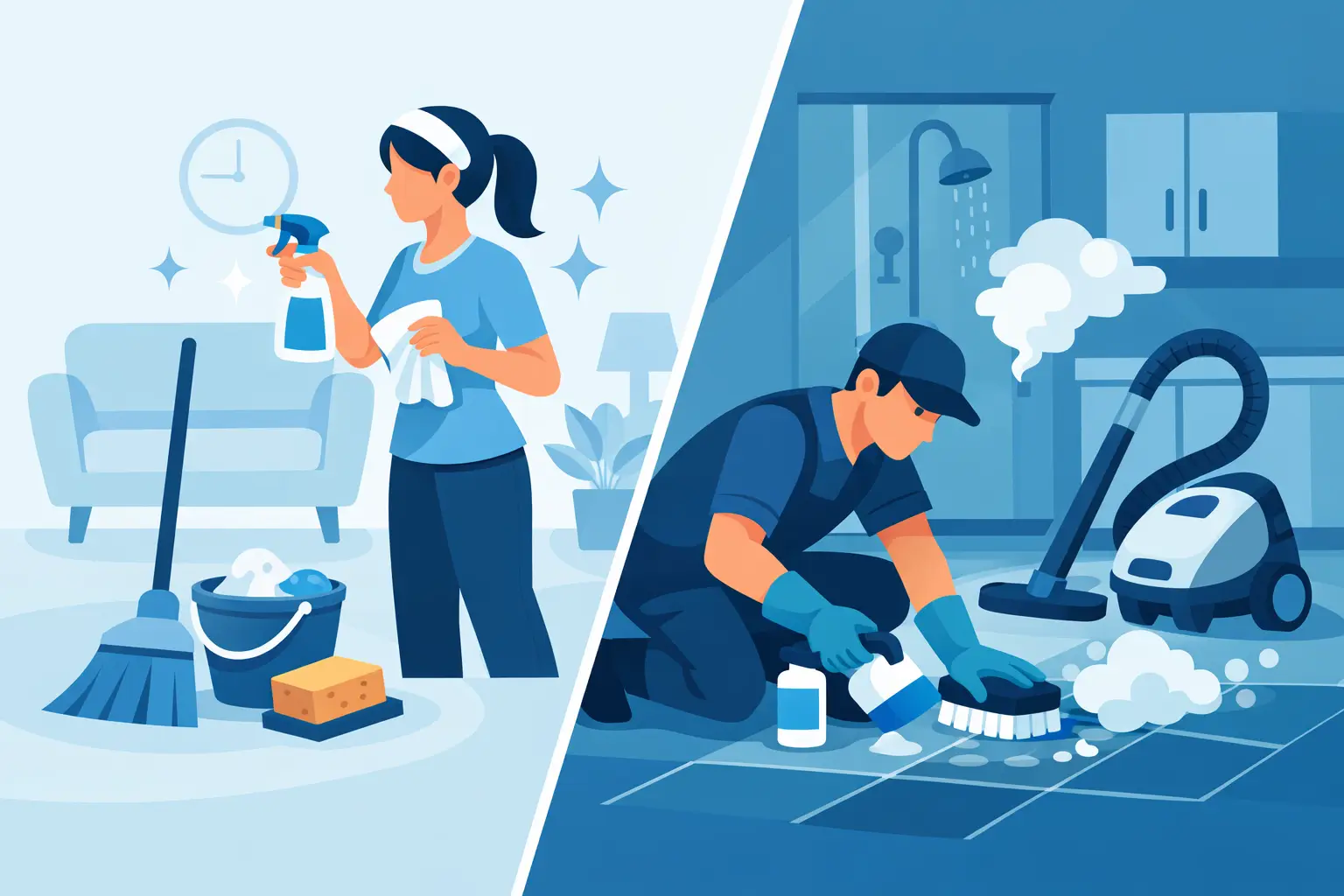
If your site looks tidy by 9am but still collects dust in the corners, marks on touchpoints and build-up in washrooms, the issue is usually not effort. It is scope. Regular cleaning vs deep cleaning is less about which one is better and more about what the premises actually need to stay presentable, hygienic and workable.
For many businesses, the two get lumped together until standards start to slip. An office manager may ask for “a deeper clean” after a client visit. A hotel may need extra support between busy periods. A warehouse may look clean at floor level while higher surfaces and hard-to-reach areas are overdue attention. Once you separate routine cleaning from periodic deep cleaning, planning becomes far simpler.
Regular cleaning vs deep cleaning: what is the difference?
Regular cleaning is the scheduled work that keeps a building in day-to-day working order. It covers the visible and high-use areas that need frequent attention to control dirt, dust, waste and general wear. In a commercial setting, that often means vacuuming, mopping, emptying bins, wiping desks or counters, cleaning washrooms, replenishing consumables and keeping entrances presentable.
Deep cleaning goes further. It is more detailed, more time-intensive and usually less frequent. It targets the areas that routine cleaning does not fully address, either because they take longer, require specialist methods or need access outside normal operating hours. That can include descaling washrooms, scrubbing grout, cleaning behind and beneath furniture, high-level dusting, internal glass, kitchen degreasing and detailed sanitising of neglected touchpoints.
The practical difference is this: regular cleaning maintains standards, while deep cleaning resets them.
Why businesses often need both
A routine cleaning schedule is essential, but it cannot do every job without becoming impractical or disruptive. If a cleaner has a fixed time window before staff arrive or after customers leave, priority naturally goes to the tasks that affect the next trading day. Floors, bins, toilets and obvious touchpoints come first. That is the right approach for continuity, but it leaves some tasks to build up over time.
That build-up is where deep cleaning has value. It deals with residue, hidden dirt and neglected areas before they turn into a bigger issue. In hospitality, that might mean refreshing guest-facing spaces to protect standards and reviews. In schools, it can mean tackling washrooms and high-contact areas during quieter periods. In factories and warehouses, it may involve detailed cleaning in zones that are safe to access only at certain times.
There is also a cost argument. Leaving everything to routine cleaning can make your regular contract heavier than it needs to be. Leaving everything to occasional deep cleans can allow standards to drift in between. The balance usually sits somewhere in the middle.
What regular cleaning usually covers
The exact scope depends on the premises, footfall and working pattern, but regular cleaning generally focuses on tasks that protect daily presentation and hygiene. In offices, this often means workstations, kitchens, toilets, floors and reception areas. In bars, shops and event venues, front-of-house cleanliness is often the first priority. In industrial settings, welfare areas and shared facilities may need more frequent attention than production zones.
What matters most is consistency. A modest but reliable routine often performs better than an ambitious schedule that is difficult to maintain. If the cleaning plan matches the site properly, regular cleaning should stop spaces from looking tired between visits and reduce the speed at which dirt accumulates.
That said, regular cleaning has limits. Time on site is usually allocated around operational realities. Staff may still be working, guests may still be checking in, and some areas may be inaccessible. That is why expecting a regular visit to cover every hidden or labour-intensive task is rarely realistic.
When deep cleaning is the better option
Deep cleaning is usually the right choice when standards have slipped, when hygiene risk is higher, or when the site needs a more thorough reset than a routine visit can provide. This often happens after busy trading periods, before inspections, after refurbishment work, at the start of a new cleaning contract or when a building has been under-cleaned for some time.
There are also sector-specific triggers. A B&B may need a deeper clean after a high-turnover period. A school may schedule one during holidays. A golf club or event venue may want detailed cleaning ahead of a function season. A new-build property may need post-build cleaning that goes well beyond standard maintenance work.
In some cases, deep cleaning is less about appearance and more about asset care. Floors last better when dirt and residue are removed properly. Washrooms remain more serviceable when scale and staining are tackled early. Staff kitchens are easier to keep under control if grease and hidden debris are not left to accumulate. Deep cleaning can reduce future workload as much as improve present standards.
Regular cleaning vs deep cleaning in different premises
The difference between the two becomes clearer when you look at how buildings are used.
In an office, regular cleaning may be enough to keep desks, washrooms and floors under control, particularly in lower-footfall areas. But if meeting rooms, kitchens and shared touchpoints are used heavily, deep cleaning at intervals helps prevent gradual decline that staff stop noticing.
In hospitality, presentation is less forgiving. A bar, hotel or B&B can look clean at a glance but still fall short if edges, upholstery, tiles or washrooms show build-up. Regular cleaning keeps the business moving. Deep cleaning protects the standard customers remember.
In a warehouse or factory, the challenge is often access and disruption. Day-to-day cleaning keeps welfare areas usable and controls obvious dirt. Deep cleaning may need to be planned around shifts, machinery downtime or health and safety procedures. The cleaning itself is only part of the job. The timing matters just as much.
Retail sits somewhere in between. Customer-facing areas need constant visual control, but stockrooms, skirting, fitting areas and back-of-house zones often benefit from periodic deeper attention. If they are ignored, the whole site starts to feel less well managed.
How often should each type of cleaning happen?
There is no fixed answer, because usage drives need. A small office with limited footfall may need regular cleaning a few times a week and deep cleaning only at intervals. A busy venue with constant public traffic may need daily regular cleaning and more frequent deep cleans in washrooms, kitchens or front-of-house spaces.
The better question is not “how often should deep cleaning happen?” but “what begins to slip if it does not happen?” If you start to notice lingering odours, ingrained dirt, stained grout, dusty vents, dull flooring or hard-to-clean washrooms, the site may be relying too heavily on routine maintenance alone.
A site visit is often the simplest way to judge this properly. Every premises has different staffing levels, opening hours, access limits and risk points. A realistic cleaning plan should reflect those factors rather than apply the same pattern everywhere.
How to choose the right approach for your business
Start with what the building must achieve day to day. If your priority is keeping staff areas clean, washrooms stocked and customer-facing areas presentable, regular cleaning is the foundation. Then look at where dirt builds up despite that schedule. Those areas usually define your deep cleaning requirement.
It also helps to be honest about timing. If cleaning must happen outside business hours to avoid disruption, that affects what can be done in one visit and how many operatives are needed. Businesses often underestimate this point. The question is not only what needs cleaning, but when it can be cleaned properly.
For that reason, outsourced commercial cleaning tends to work best when the scope is tailored rather than guessed. A practical contractor will assess the site, the hours required and the right level of cover, instead of forcing everything into a standard package. That is especially useful for mixed-use premises or sites with changing demand.
For businesses across Peterborough, that flexibility can make the difference between cleaning that simply happens and cleaning that actually supports operations.
The common mistake to avoid
The most common mistake is treating deep cleaning as a rescue job only when standards have already fallen too far. By that stage, the work often takes longer, causes more disruption and costs more than it would have done with better planning.
A more sensible approach is to use regular cleaning for control and deep cleaning for prevention. That keeps standards steadier, protects the working environment and avoids the stop-start cycle where issues are ignored until they become urgent.
If you are reviewing your current cleaning setup, look beyond whether the building appears clean at first glance. Ask whether the schedule matches the way the premises are used, whether hidden areas are being dealt with at the right time, and whether cleaning support can scale when demand changes. That is usually where the right answer sits.