
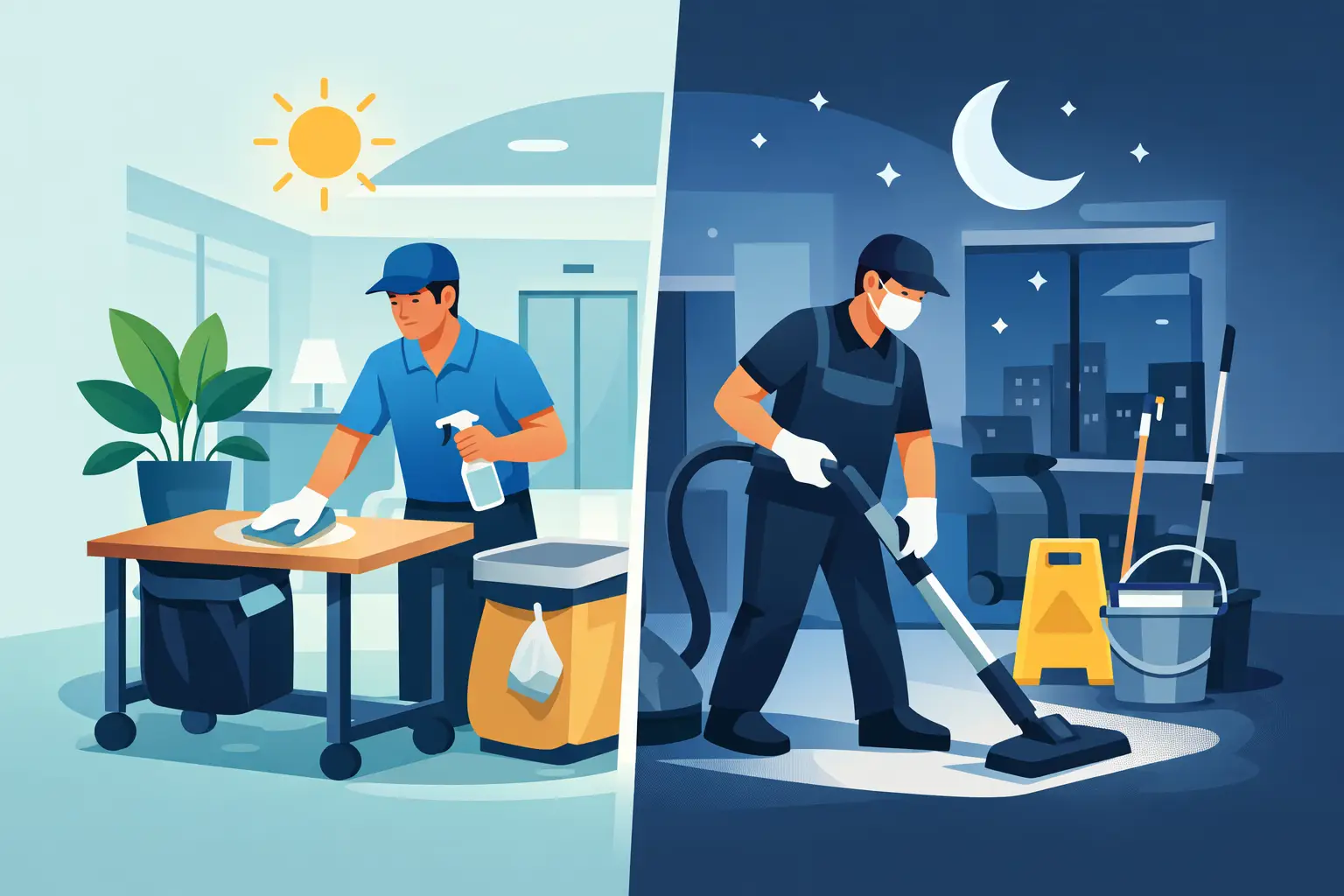
If your toilets are tidy at 9am but look tired by noon, or your reception needs constant attention while the rest of the site only needs a proper clean after hours, the question of day porter vs contract cleaning becomes a practical one very quickly. For many businesses, the right answer is not about which service sounds better. It is about what keeps the building presentable, safe and operational with the least disruption.
What day porter vs contract cleaning actually means
A day porter works on site during business hours. Their role is to keep the premises presentable and deal with issues as they arise. That might include checking washrooms, topping up consumables, spot-cleaning entrances, clearing litter, wiping touchpoints, tidying shared spaces and responding to spills or mess during the day.
Contract cleaning usually refers to planned cleaning carried out at agreed times, often early morning, evening or overnight. It is structured, repeatable and based on a schedule. Typical tasks include vacuuming, mopping, dusting, washroom cleaning, bin emptying and deeper routine work carried out daily, several times a week or to a bespoke programme.
The key difference is timing and purpose. A day porter helps maintain standards while the site is in use. Contract cleaning restores the site to a set standard at planned intervals.
Day porter vs contract cleaning: the operational difference
For a facilities manager or business owner, the main distinction is not just who cleans what. It is how the service supports the day-to-day running of the building.
A day porter is reactive as well as preventative. They are there to deal with traffic, weather, footfall and the small issues that make a site feel unmanaged if left too long. In a busy office, school, hotel or retail setting, that visible presence can make a real difference. Entrance mats get checked, fingerprints do not build up on glass, and washrooms are kept in order through the day rather than left until the evening.
Contract cleaning is more task-led. The cleaning team arrives at agreed times, completes a scope of work and leaves the premises ready for the next trading period. This works well where cleaning needs are predictable and where it is easier to clean when fewer people are on site. Offices, warehouses, schools and many commercial units often suit this model because it avoids disrupting staff, customers or visitors.
Neither service is automatically better. It depends on how your building is used.
When a day porter makes more sense
A day porter is usually the stronger option where appearance, responsiveness and continuous upkeep matter throughout opening hours. Hospitality venues, customer-facing offices, shopping environments, busy schools and event spaces often fall into this category.
If the site sees regular visitors, washrooms need frequent checks or entrance areas get dirty quickly in wet weather, having someone available during the day can prevent standards slipping between scheduled cleans. This is also useful where internal teams should not be pulled away from their own roles to deal with cleaning issues.
There is, however, a cost consideration. Because a day porter is on site during working hours, this can be more labour-intensive than a standard out-of-hours contract. The value comes from ongoing support and immediate response rather than from one single clean.
When contract cleaning is the better fit
Contract cleaning is often the more efficient choice when your site needs reliable, repeatable cleaning without full daytime cover. If your premises can be cleaned properly before staff arrive, after they leave or during low-traffic periods, a contract arrangement is usually the simplest way to maintain standards.
This suits many offices, industrial units, smaller schools, B&Bs, bars before opening, and commercial spaces where the main goal is to start each day clean and ready. It also gives a clearer structure for budgeting because the service is based on agreed frequencies, hours and tasks.
For some businesses, contract cleaning covers everything required. If there is limited public footfall and no real need for daytime intervention, paying for a porter may add cost without adding enough operational benefit.
The cost question is really about site use
When people compare day porter vs contract cleaning, they often start with price. That is understandable, but price on its own can be misleading.
A cheaper out-of-hours clean may not solve the problems caused by heavy daytime use. If washrooms run out of stock, litter builds up at entrances or customer areas look neglected by midday, the lower contract cost can be offset by complaints, poor presentation or staff time spent dealing with issues.
At the same time, a day porter is not always the most efficient answer. If your building stays relatively tidy during the day and the main requirement is a thorough clean at fixed times, contract cleaning will usually offer better value.
The better way to assess cost is to look at footfall, building size, opening hours, customer visibility and the consequences of standards dropping during the day. A warehouse office with limited visitors has different needs from a hotel reception or a school with heavy washroom use.
Many businesses need both
In practice, this is often not an either-or decision. A lot of commercial sites work best with both services in place.
A contract cleaning team can handle the core scheduled work out of hours, while a day porter keeps key areas under control during trading hours. That combination is common in larger premises or sites where presentation matters all day, but where proper floor cleaning, washroom sanitation and detailed tasks are still best done when the building is quieter.
This blended approach can also be adjusted around peak times. For example, a venue may need porter support only on event days, or a school may need extra daytime attention during term time but not during holidays. That flexibility matters more than labels.
How to choose the right model for your premises
The best starting point is not a cleaning package. It is a site assessment based on how the building actually operates.
Look at when your premises get busiest, which areas deteriorate fastest and whether cleaning needs are mostly predictable or arise during the day. Ask yourself where poor presentation is most likely to be noticed. Reception, washrooms, stairwells, kitchens, corridors and entrances tend to drive complaints faster than back-office areas.
It also helps to be honest about disruption. Some sites are easy to clean after hours. Others need support while open because waiting until the end of the day is too late. If your team currently handles ad hoc tidying, check how much time that is costing the business. It is often more than expected.
A dependable contractor should be able to recommend staffing levels and cleaning hours based on the building, not force you into a fixed template. That matters especially for mixed-use sites or premises with changing demands across the week.
Common mistakes when comparing day porter vs contract cleaning
One common mistake is choosing contract cleaning when the site clearly needs daytime upkeep. The cleaning itself may be done well, but the building still looks tired for most of the day because no one is managing the wear and tear between visits.
Another is assigning porter duties where a structured contract clean is the real gap. A day porter can keep things ticking over, but they are not a substitute for a proper scheduled clean that covers floors, washrooms, surfaces and hygiene routines thoroughly.
There is also the issue of underestimating busy periods. Seasonal demand, events, wet weather, school terms or peak trading hours can change what your building needs. A rigid service plan often fails at exactly the point when standards matter most.
Why the right cleaning structure matters
Cleaning is easy to notice when it goes wrong. Overflowing bins, untidy entrances and neglected washrooms affect how staff, visitors and customers judge the whole operation. In some environments, it also affects safety, compliance and employee morale.
That is why the choice between day porter and contract cleaning should be treated as an operational decision, not just a housekeeping one. The right structure supports the way your business runs. The wrong one creates avoidable friction.
For businesses in Peterborough and the surrounding area, that often means looking closely at site hours, footfall and the level of flexibility needed from a contractor. A straightforward conversation and a proper look at the premises usually tell you far more than a standard price list ever will.
If you are weighing up day porter vs contract cleaning, the useful question is simple: do you need your site cleaned at set times, maintained throughout the day, or both? Once that is clear, the right service tends to follow.