
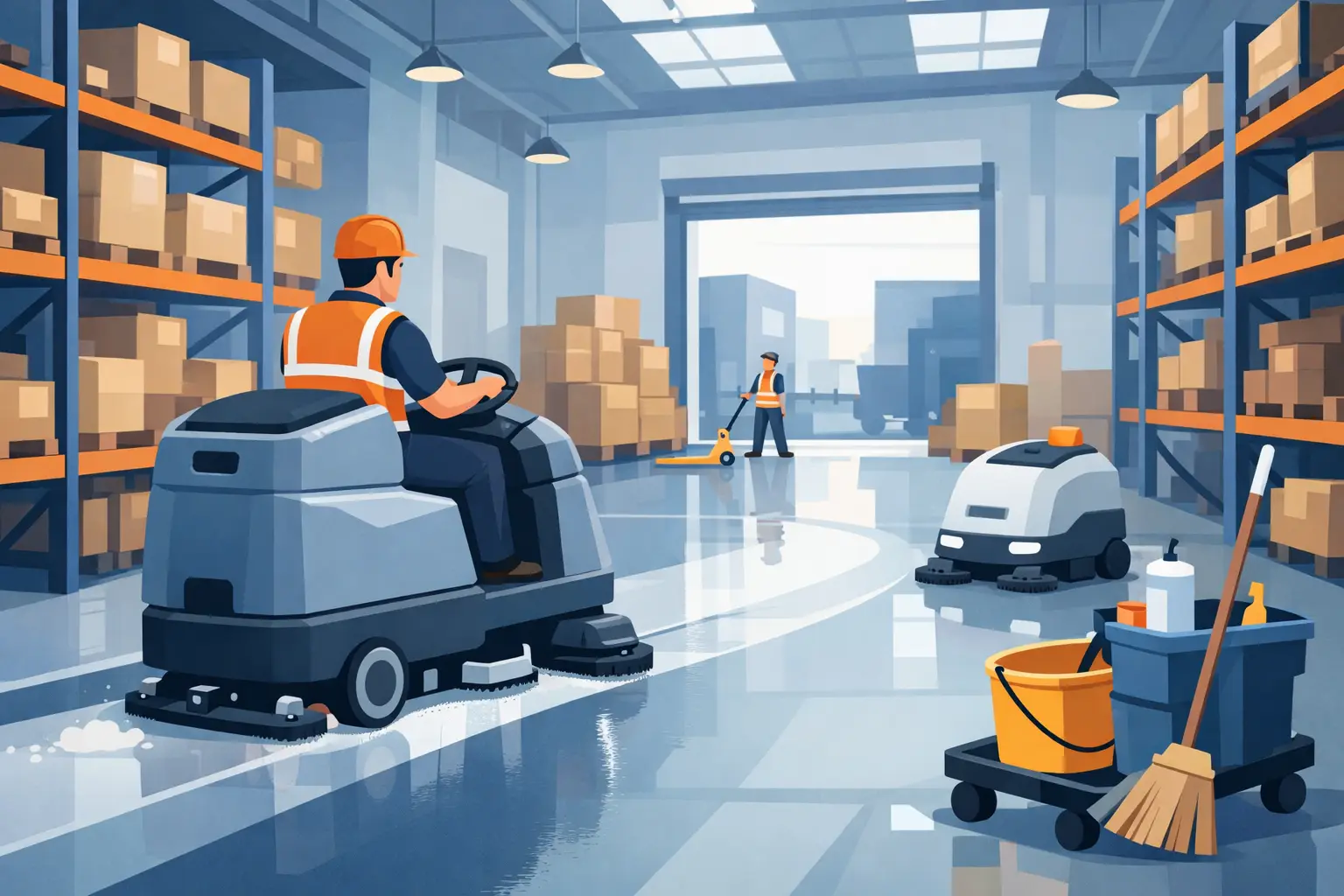
A warehouse floor rarely gets dirty in a neat, predictable way. Dust builds along racking, tyre marks appear in loading areas, spills happen without warning, and pedestrian walkways can go from clear to hazardous in a single shift. That is why a solid warehouse floor cleaning guide matters – not as a box-ticking exercise, but as part of keeping the site safe, presentable and operational.
For most warehouses, the challenge is not whether the floor needs cleaning. It is how to keep on top of it without slowing down goods in, goods out, picking, packing or vehicle movement. The right approach depends on the floor type, the traffic level, the stock handled and the hours your site actually runs. A small storage unit and a high-volume distribution space will not need the same routine.
What a warehouse floor cleaning guide should cover
A useful warehouse floor cleaning guide starts with risk, not appearance. Dust, loose debris and liquid spills are safety issues before they are cleaning issues. Forklift traffic can spread grime quickly, and once dirt is ground into the surface, routine cleaning takes longer and costs more.
The guide should also reflect how the building is used. Some sites mainly deal with dry goods and packaging waste. Others contend with oil residues, pallet splinters, mud tracked in from yards or fine dust from manufacturing activity. If the cleaning plan ignores those realities, it usually fails within days.
In practical terms, the floor plan should identify loading bays, aisles, pedestrian routes, picking zones, storage areas and welfare spaces. These all soil at different rates. Treating the whole warehouse the same sounds simple, but it often leads to wasted labour in low-traffic areas and missed risks where the pressure points really are.
Start with the floor itself
Before setting any schedule, check what surface you are cleaning. Sealed concrete, power-floated concrete, painted floors and resin systems all behave differently. Some tolerate aggressive scrubbing well. Others can wear prematurely if the wrong pad, chemical or machine setting is used.
This matters because the wrong method can create a bigger problem than the dirt. Over-wetting unsealed or damaged concrete may leave patches, while strong chemicals can dull coatings or leave slippery residue. In older warehouses, repairs and worn areas may also trap dirt more easily, which means those sections need extra attention even if the rest of the floor is straightforward.
If you are unsure about the finish, it is better to confirm first than to guess. A cleaning routine should protect the floor as well as improve it.
Daily cleaning priorities in a working warehouse
Most sites do not need a full deep clean every day, but they do need consistent daily control. That usually begins with dry debris removal. Cardboard fibres, dust, shrink wrap fragments and pallet waste should be removed before they are spread across the warehouse by footfall or machinery.
Sweeping can work in small areas, though in larger spaces it is often inefficient and can push dust into the air. A suitable industrial sweeper or scrubber dryer is usually the better option where floor area and traffic justify it. The key point is timing. Cleaning during peak movement can create delays and increase risk, so early morning, late evening or out-of-hours support is often the most practical choice.
Spill response should sit alongside the daily routine, not outside it. If liquids are left until the next scheduled clean, the floor becomes unsafe and contamination can spread. Staff need a clear process for isolating and reporting spills, with the cleaning team able to respond quickly.
Choosing the right method for the site
There is no single best method for every warehouse. Manual sweeping and mopping may suit a small unit with light traffic, but it will not be enough for a larger premises with constant forklift use. Equally, bringing in a large machine for a compact warehouse with narrow aisles may be impractical.
For many commercial sites, the most effective approach combines methods. Dry removal first, then machine scrubbing where needed, with spot treatment for stains, spills and marked areas. That keeps the process efficient and avoids using water or chemicals where they are not necessary.
Chemical choice also depends on the environment. In a general storage warehouse, a neutral cleaner may be enough for routine work. In industrial settings, grease or heavy soiling may require stronger products, but these should always be matched to the floor finish and used at the correct dilution. More product is not automatically better. It can leave residue, increase drying times and make the floor harder to maintain.
High-traffic zones need a different standard
If one part of the warehouse always looks worse than the rest, that is usually because it is carrying more of the operational load. Loading bays, despatch lanes, entrances and bin storage points often need cleaning more frequently than central storage aisles.
This is where many plans become too rigid. A weekly clean across the full floor may sound organised, but if loading areas need attention every day, the schedule is not fitted to the site. A better system separates routine whole-floor maintenance from targeted cleaning in high-impact zones.
Pedestrian walkways deserve particular attention. They are often the first places where a site visitor or auditor notices dirt, but more importantly they need to stay safe and clearly defined. Dust build-up, tyre marks across marked routes and damp patches all undermine that.
Building a realistic cleaning schedule
A good cleaning schedule is one your site can actually maintain. That means matching frequency to traffic levels, staffing and opening hours rather than producing an ideal plan that only works on paper.
For some businesses, daily dry cleaning plus a weekly machine scrub is enough. For others, especially where stock movement is continuous, there may need to be daily machine cleaning in selected areas and periodic deep cleaning across the whole site. Seasonal changes matter too. Wet weather can bring in mud and moisture from yards, which increases the burden on entrances and loading doors.
It also helps to define what counts as routine cleaning and what counts as restorative cleaning. Routine work keeps the floor safe and under control. Restorative work deals with ingrained dirt, staining and neglected areas that need a more intensive approach. If the second part is ignored for too long, the first becomes harder and more expensive.
Where operations run across long hours or multiple shifts, flexible scheduling makes a real difference. That is often why businesses use an external cleaning provider – not just for labour, but for the ability to work around site activity without disrupting it.
Why inspections matter as much as cleaning
Cleaning should not be left to assumption. If no one checks standards, the routine can drift, especially in large warehouses where issues in one corner are easy to miss. Simple inspections help identify where debris collects, where marks are recurring and whether the current schedule is still doing the job.
They also show when site conditions have changed. A new product line, altered traffic routes or increased dispatch volume can all affect floor cleanliness. The cleaning plan should change with the operation.
For facilities managers and site leads, this is often where outside support proves useful. A site visit can help assess not only the area to be cleaned, but also the number of cleaning hours and staff needed to keep standards practical and consistent.
Common mistakes that create more work
The biggest mistake is leaving the floor until it looks visibly bad. By then, dirt has usually spread, marks have set in and cleaning takes longer. Another common issue is using the wrong machine or method for the space, which either slows the job down or fails to clean properly.
There is also a tendency to focus on the main open floor and forget edges, corners, under racking fronts and around loading thresholds. Those areas collect dust and debris quickly. If they are ignored, the whole warehouse can start to look poorly managed even when the central aisles are being cleaned.
Finally, some sites rely too heavily on ad hoc internal cleaning when what they really need is a planned commercial routine. That works for a while, then standards slip when operational priorities take over.
When to bring in professional support
If your team is struggling to keep the warehouse floor safe and presentable alongside day-to-day operations, it is usually time to review the setup. That does not always mean a full-time contract. In some cases, it means scheduled visits, out-of-hours support or periodic deep cleaning to bring standards back under control.
For businesses in Peterborough and the surrounding area, that flexibility can be especially useful where shifts, deliveries and site access vary week to week. The right cleaning support should fit around the operation, not force the operation to fit around cleaning.
A warehouse floor does not need a complicated plan. It needs a realistic one, backed by the right equipment, the right timing and a standard that matches how the building is used. When that is in place, cleaning stops being a recurring disruption and becomes part of keeping the site running properly.