
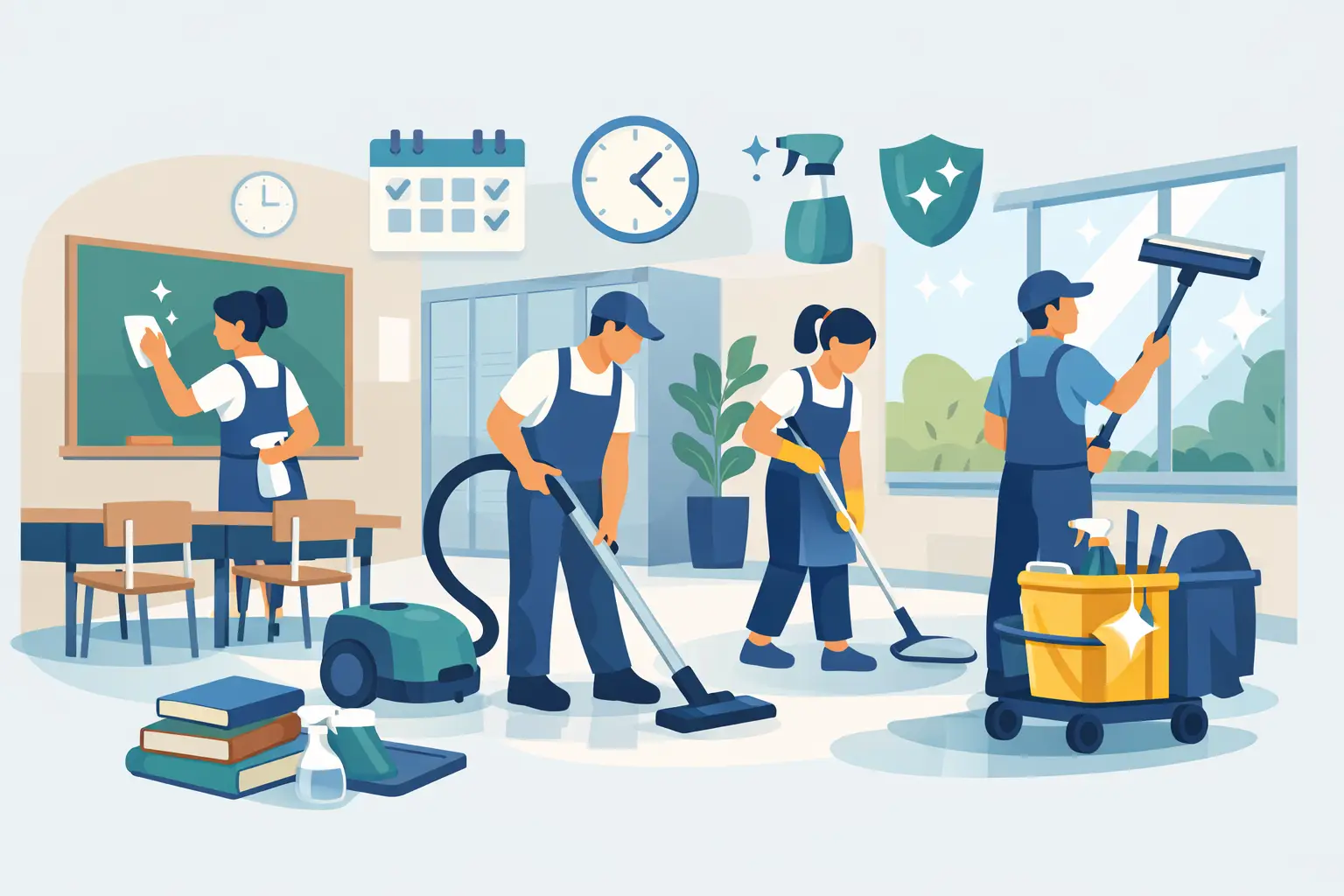
When a school cleaning plan slips, the problems show up quickly. Toilets run short, touchpoints get missed, bins overflow and staff start raising the same issues every week. The best cleaning schedule for schools is not the one with the longest checklist. It is the one that fits the building, the footfall and the hours available without disrupting the school day.
For site managers, facilities teams and school leaders, that usually means building a schedule around risk, usage and timing. A primary school with heavy toilet use and messy classrooms needs a different pattern from a sixth form with longer independent study periods. A small site may cope with one main clean and a daytime touchpoint check. A larger campus may need early morning, daytime and evening cover.
What the best cleaning schedule for schools needs to cover
A workable school schedule starts with the spaces that affect hygiene, safety and first impressions first. Toilets, washrooms, dining areas, entrances and high-touch surfaces need more attention than low-use storage spaces. That sounds obvious, but many schedules still spread time too evenly across the building.
In practice, cleaning time should be weighted towards areas that carry the most traffic and the most complaints. Toilet blocks, reception areas, staff rooms, corridors, handrails, door plates and dining furniture all need frequent attention. Classrooms matter too, but not every classroom needs the same level of time every day. Art rooms, food technology rooms and early years spaces usually need a heavier clean than a standard office-style teaching room.
The other point is access. School cleaning has to work around pupils, teachers, lettings, breakfast clubs, after-school clubs and occasional events. The best schedule is realistic about when rooms are actually available. If cleaners are always waiting for access, the plan is wrong before the shift even starts.
Daily cleaning tasks that should not be missed
Daily work is the backbone of any school cleaning schedule. If these tasks are inconsistent, weekly and termly work becomes harder and standards drop fast.
Washrooms need daily cleaning without exception, and on busy sites they often need checking more than once. Toilets, urinals, basins, taps, mirrors, dispensers and cubicle touchpoints should all be cleaned and restocked. Floors need attention too, especially around entrances and sinks where dirt and slip risks build up.
Classrooms need a dependable end-of-day routine. That usually includes emptying bins, wiping desks and touchpoints, cleaning teacher stations, spot-cleaning marks and vacuuming or mopping floors as required. The detail depends on age group and use. A reception class after a wet day will not need the same approach as a maths room used by older pupils.
Circulation areas should also be treated as daily priorities. Entrances, corridors, stairwells and reception spaces collect dirt quickly and affect the overall impression of the site. These areas also carry a higher volume of hand contact, so handrails, push plates and door handles should sit firmly in the daily schedule.
Dining spaces need careful timing. Cleaning before service, between sittings where needed, and after lunch can all be necessary depending on pupil numbers and catering setup. If the hall is used for assemblies or sport as well, the schedule has to reflect that shared use rather than treating it as a standard room.
Weekly and periodic tasks that keep standards stable
The best cleaning schedule for schools does not rely on daily tasks alone. Some jobs can be rotated across the week or planned at set intervals, which helps keep labour hours under control while still maintaining standards.
Weekly work often includes deeper attention to skirting, lower wall marks, internal glass, partition edges, chair and table legs, and more detailed floor care. In staff and admin areas, this may also include dusting higher surfaces and cleaning around equipment where daily access is awkward.
Periodic tasks should be built around the school calendar. Machine scrubbing hard floors, carpet deep cleaning, high-level dusting, descaling washrooms, internal window cleaning and full kitchen support cleaning all need space in the plan. These jobs are often better scheduled for inset days, holidays or low-occupancy periods rather than forced into ordinary evening shifts.
That is where many schools get caught out. If periodic work is left vague, it tends to be postponed until the site looks tired. A proper schedule gives these tasks dates, estimated hours and clear responsibility.
How to structure a school cleaning timetable
A good timetable is usually split into three layers: during the day, after school and holiday or periodic work. That structure gives enough control without becoming overcomplicated.
Daytime cleaning support
Not every school needs a full daytime team, but many benefit from at least some daytime cover. This is especially true for larger schools, SEND settings, sites with heavy community use or buildings with toilet blocks that receive constant use.
Daytime cover is useful for washroom checks, emergency spill response, entrance cleaning in bad weather and keeping touchpoints under control during busy periods. It also reduces pressure on the evening team, who can then focus on full-room cleaning rather than constant catch-up work.
After-school cleaning
The main clean often happens after pupils leave. This shift usually covers classrooms, offices, common areas, washrooms and floor care. The key is to sequence the work properly so teams are not overlapping unnecessarily or missing rooms used by clubs and lettings.
On some sites, it makes sense to clean admin and front-of-house areas first, then move into teaching spaces as they become available. On others, cleaners may need a later start because sports halls and classrooms are occupied well into the evening. The right answer depends on the site, not on a standard template.
Holiday and term-break cleaning
School holidays are when deeper tasks should be done properly. Stripping and refinishing floors, carpet extraction, internal glazing, high-level work and full washroom descaling are easier and safer when rooms are empty.
This is also the best time to deal with problem areas that have been managed rather than resolved during term time. A holiday clean should not just repeat the evening routine on a quieter site. It should reset standards for the next term.
Common mistakes when planning school cleaning
The first mistake is underestimating washroom demand. Many complaints start there, and they escalate quickly. If toilet checks and restocking are not matched to pupil numbers and break times, standards fall regardless of how well other spaces are cleaned.
The second is treating every room the same. Cleaning hours should follow use, mess and risk. A science lab, food room and nursery class should not be given the same time allowance as a low-use meeting room.
The third is ignoring seasonal pressure. Autumn and winter bring more mud, wet floors and illness-related concerns. Exam periods, productions, parents’ evenings and lettings can all change how the site is used. A fixed schedule with no flexibility usually fails when conditions change.
Another issue is building a plan around ideal access rather than real access. If cleaners are repeatedly arriving to occupied rooms, the schedule needs to be reworked with the school rather than left to fail shift after shift.
Staffing levels and why site visits matter
A school cleaning schedule is only as good as the staffing behind it. Too few hours means standards slip. Too many hours means unnecessary cost. The right balance comes from understanding the building properly, including layout, room count, floor types, occupancy and access windows.
That is why site assessment matters. Square footage alone does not tell you enough. Two schools of similar size can need very different labour levels depending on age range, room use, staircases, washroom numbers and whether the premises are used outside normal hours.
For that reason, many schools are better served by a tailored schedule than by a standard package. Peterborough Business Cleaners works in exactly that practical way, assessing site requirements and staffing needs so cleaning hours reflect the building as it actually operates.
What a realistic schedule looks like
In most schools, a realistic plan combines fixed daily standards with flexible response time. Daily tasks should be non-negotiable in washrooms, touchpoints, bins and floor presentation. Classroom cleaning should be consistent but adjusted where specialist rooms need more time. Weekly rotations should handle the detail work that stops the site looking worn. Holiday periods should be reserved for deeper cleaning that cannot be done properly during term.
There is also a trade-off between frequency and depth. A school may choose more daytime checks and a lighter evening clean, or fewer daytime hours with a larger after-school team. Neither approach is automatically better. It depends on occupancy, budget and the level of disruption the site can tolerate.
The best results usually come from a schedule that is reviewed regularly rather than left unchanged all year. If complaint patterns, sickness absence, weather conditions or lettings are affecting standards, the timetable should move with them.
A school does not need the most complicated cleaning plan. It needs one that can be delivered reliably, week after week, by the right number of people at the right times. That is what keeps the site clean, manageable and ready for the next school day.