
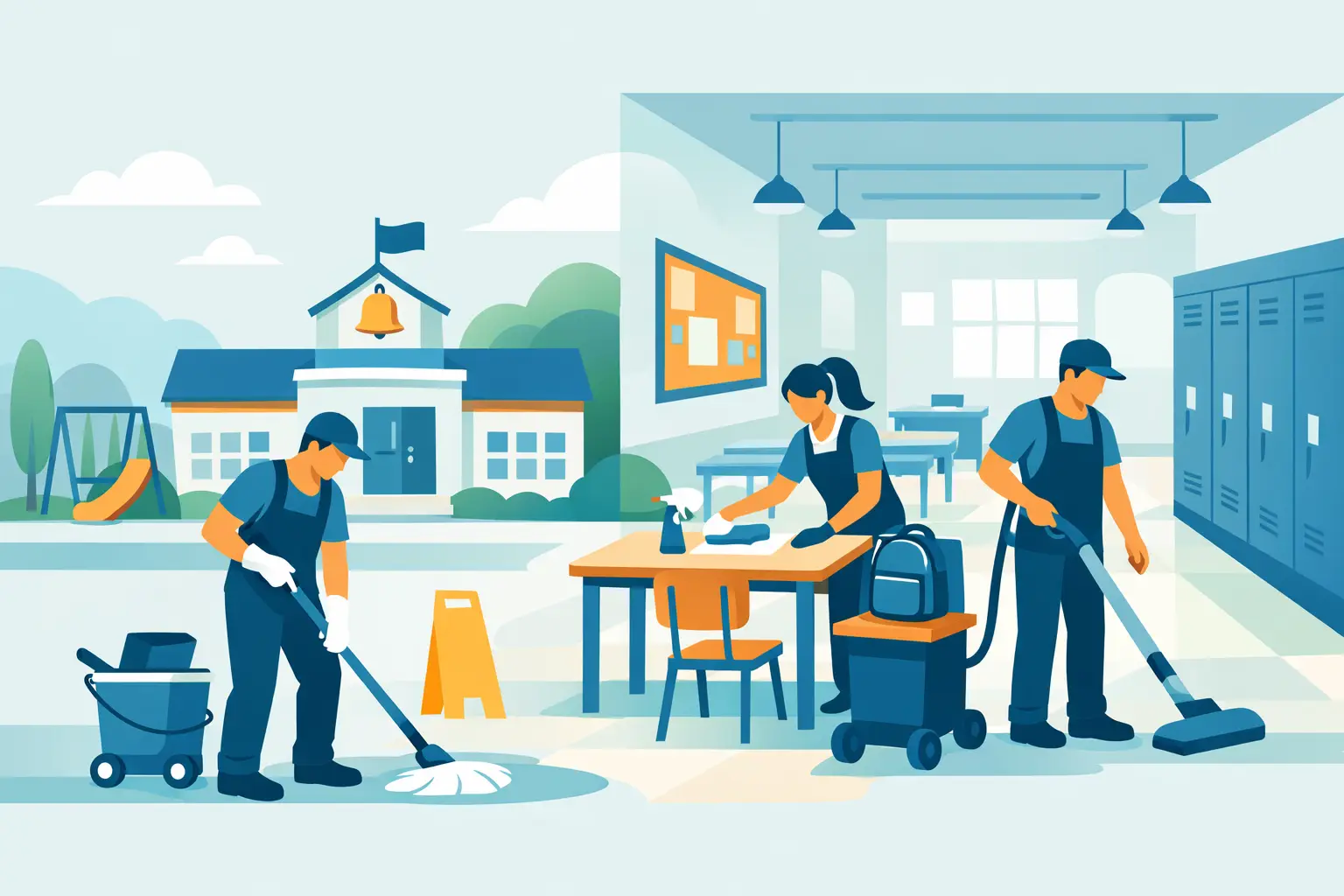
A school can look fine at 8.15am and still have hygiene problems building up across the day. Toilets get heavy use, entrance areas carry in grit and water, dining spaces need regular attention, and touchpoints are handled by hundreds of pupils and staff. That is why school cleaning services need to be planned around how the building is actually used, not just around a generic after-hours clean.
For headteachers, site managers and trust facilities teams, the main issue is rarely whether cleaning matters. It is whether the service is reliable enough to support attendance, safety and day-to-day operations without creating extra work for staff. A cleaning contractor has to understand that schools are busy, time-sensitive environments. If standards slip, the impact is immediate.
What good school cleaning services should cover
A proper school cleaning plan starts with the building layout and the daily timetable. Classrooms, corridors, reception areas, staff rooms, toilets, changing spaces, dining halls and sports facilities all have different usage patterns. The cleaning requirement for a small primary school is not the same as the requirement for a large secondary site with specialist rooms and extended opening hours.
In practical terms, most schools need routine cleaning that keeps the site presentable and hygienic every day, with added attention in high-traffic areas. Entrance mats and floor care matter more in wet weather. Toilet cleaning may need checking during the day as well as after hours. Dining areas often need a different approach from teaching spaces because waste, spills and food debris create a separate hygiene risk.
A good contractor should also be realistic about staffing levels. If a site needs more than one cleaner to complete the job properly within the available time, that should be built into the quote from the start. Understaffing is one of the main reasons school cleaning quality drops.
Why schools need a site-specific cleaning plan
The phrase school cleaning services covers a wide range of buildings. A village primary with six classrooms and one hall can often work to a straightforward routine. A larger academy, college or mixed-use education site may need split shifts, more supervisors, and periodic deep cleaning to stay on top of the workload.
This is where site visits matter. On paper, two schools may look similar in size, but one may have more toilets, more external entrances, more dining turnover or longer opening hours. The age of the building also makes a difference. Older sites can need more detailed floor care, more attention to washrooms, and more time for dust control where ventilation and layout are less efficient.
There is also the issue of access. Some schools want all cleaning completed after pupils leave. Others need early-morning support, holiday cleaning, or extra cover after lettings and evening use. Flexibility matters because schools rarely operate on one fixed pattern all year.
High-risk areas that need closer attention
Not every space in a school carries the same level of risk. Toilets, washrooms, food service areas and frequently touched surfaces need a higher standard of attention than lower-use storage areas or occasional meeting rooms. That does not mean everything else can be ignored, but priorities need to be clear.
Touchpoints deserve particular focus. Door handles, push plates, stair rails, desks, taps and flush points are handled constantly. In a busy school, these areas can deteriorate quickly between cleans. The right response depends on the site and budget. Some schools need a standard end-of-day routine. Others benefit from daytime support for washrooms and touchpoint cleaning, especially during periods of high illness absence.
Flooring is another area where shortcuts show. Corridors and entranceways take a lot of wear, and poor floor maintenance affects both appearance and safety. Dirt build-up around edges, wet entrances and neglected hard floors can make a site look unmanaged even when classrooms are in reasonable condition.
Timing matters as much as quality
A cleaning specification may look fine on paper and still fail in practice if the schedule does not match the school day. That is one of the more common problems with outsourced contracts. Work is assigned, but not at the right time, or not with enough labour to meet the window available.
Schools need a contractor that can work around assemblies, breakfast clubs, after-school activities, lettings and exam periods. During school holidays, the focus may shift towards deep cleaning, internal glass, high-level dusting or floor treatment. During term time, the priority is consistency and minimal disruption.
There is no single right model. Some sites want a full evening clean five days a week. Others need a mixture of daily maintenance and periodic specialist work. What matters is that the provider can adapt without turning every change into a problem.
Compliance, safeguarding and trust
Any contractor working in education needs to understand that cleanliness is only one part of the job. Reliability, conduct and access control matter just as much. Schools are safeguarding environments. Cleaning teams need to follow site procedures properly, work within agreed access arrangements and respect the operational structure of the building.
This is where a dependable contractor stands apart from a cheap one. If keyholders are late, staff change constantly, or attendance is patchy, the school ends up carrying the risk. A missed clean in an office is inconvenient. In a school, it can affect hygiene, opening readiness and confidence in the service.
For that reason, schools should ask practical questions before appointing a cleaner. Who supervises the work? How is absence covered? What happens if there is an urgent issue on site? Can the provider increase staffing during busy periods or respond at short notice if a problem needs dealing with? Those questions are usually more useful than broad promises.
What to look for in a school cleaning contractor
The best fit is usually a company that is straightforward about scope, staffing and response times. Schools do not need inflated claims. They need a cleaning partner that turns up, works to specification and communicates clearly when something changes.
A site assessment is often the best starting point because it allows the contractor to judge cleaning hours properly and identify any operational issues before the service begins. That is especially useful for schools with a mix of classrooms, halls, offices and specialist spaces. It reduces the chance of unrealistic quotes and avoids disputes later.
It also helps to work with a provider that has experience across different commercial environments. While schools have their own pressures, the operational discipline needed to clean offices, hospitality venues, retail sites and industrial spaces often translates well. The key is whether the contractor adjusts the service to education settings rather than applying the same routine everywhere.
For schools in Peterborough and surrounding areas, local coverage can be an advantage when response times matter. A provider with flexible scheduling and the ability to attend outside normal hours is often better placed to support term-time cleaning, holiday work and occasional urgent requirements.
When a standard contract is not enough
Some schools manage well with a regular daily clean and periodic holiday work. Others need more support at certain times of year. Winter brings mud, moisture and heavier washroom usage. Exam season can require more careful scheduling. End-of-term periods often call for deeper classroom and hall cleaning, especially on multi-use sites.
There are also occasions when schools need short-notice support. That might be cover for an internal cleaning team, cleaning after building works, or extra attendance following events and lettings. A rigid contract can struggle with these changes. A more responsive service is often worth more than a slightly lower headline price.
That does not mean every school needs the most comprehensive package available. Budgets matter, and cleaning plans need to be realistic. But it is usually better to have a clear, properly resourced specification for priority areas than an overpromised full-site service that cannot be delivered consistently.
A practical standard schools can work to
Good school cleaning is not complicated in theory. The site should be ready for the day, washrooms should stay under control, touchpoints and floors should not be neglected, and the contractor should be easy to reach when something needs attention. The difficulty is delivering that standard consistently across changing term-time demands, staffing pressures and different building types.
That is why schools tend to value the same things over and over again: reliability, clear communication, sensible staffing levels and a service that fits the timetable. Peterborough Business Cleaners works in that practical way – assessing the site, understanding cleaning-hour requirements and providing support that matches the building rather than forcing the building to fit a fixed package.
If you are reviewing your current provision, the simplest test is this: does the cleaning arrangement make the school easier to run, or harder? If it creates regular follow-up, missed areas and avoidable complaints, it is probably time for a more workable plan.
Leave a Reply