A missed clean in a warehouse might slow picking, create slip risks or leave dust building up around racking. A missed clean in a factory can interfere with production, hygiene controls or machinery performance. That is why warehouse cleaning vs factory cleaning is not a minor distinction. For site managers and operations teams, the cleaning plan has to match how the building actually works.
Both environments are industrial, both need reliable cleaning support, and both often require work outside standard hours. But the priorities, risks and methods are different. If you are pricing a contract, reviewing standards or arranging cover for a busy site, it helps to understand where those differences sit.
Warehouse cleaning vs factory cleaning: the core difference
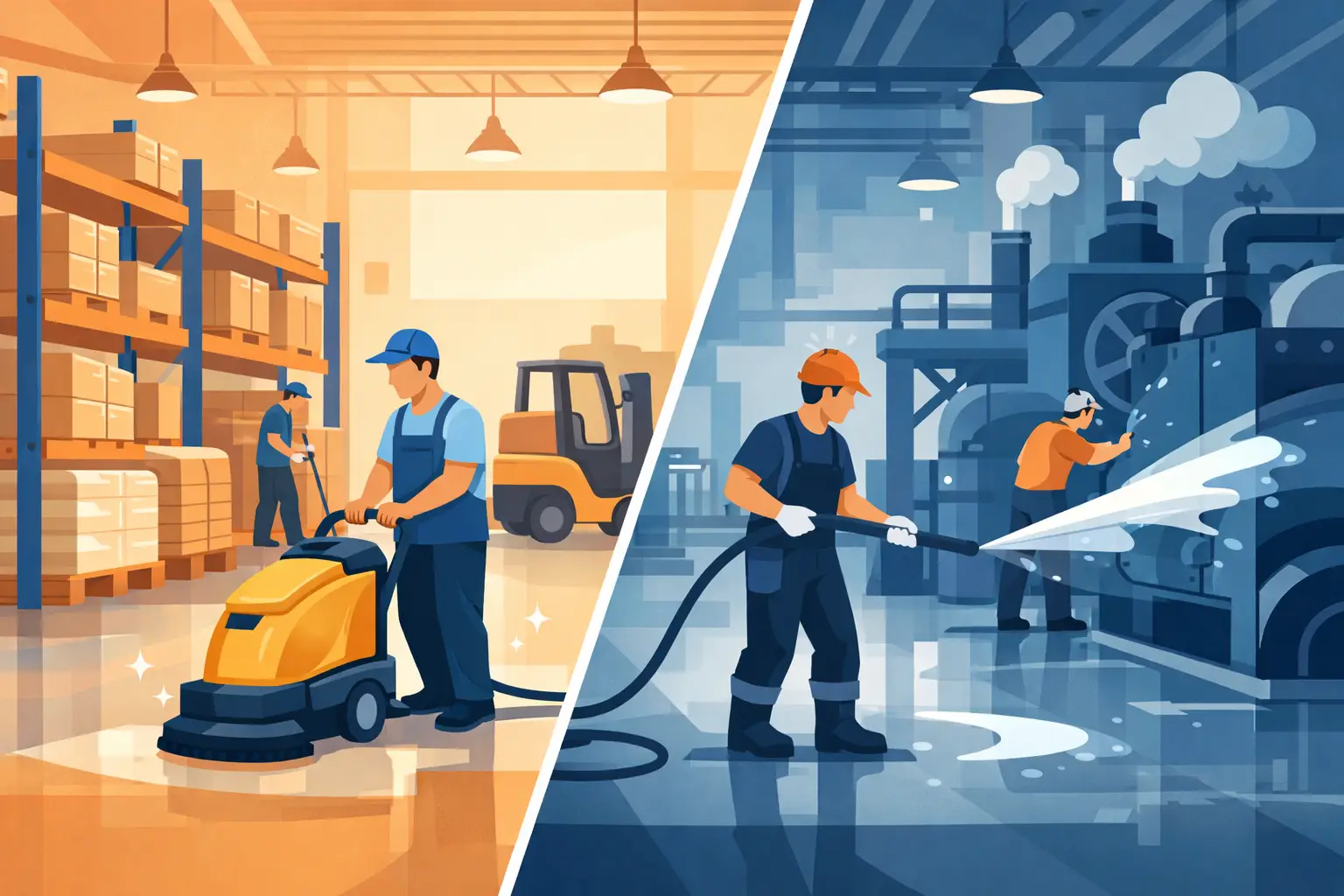
The simplest way to separate the two is this: warehouses are mainly about storage, movement and dispatch, while factories are about processing, assembly or production. Cleaning in each setting follows that reality.
In a warehouse, the main focus is usually on keeping floors safe, access routes clear, dust under control and shared areas presentable and usable. The traffic pattern matters a great deal. Forklifts, pallet trucks, loading bays and pedestrian routes all create dirt in different ways. A warehouse clean often needs to work around stock movements, intake schedules and dispatch deadlines.
In a factory, cleaning usually sits closer to production risk. Depending on the type of site, that can mean residue removal, control of fine dust, managing spills, cleaning around equipment, washroom and welfare maintenance, and supporting hygiene or compliance requirements. Even where the site is not food-related or highly regulated, cleaning often has a more direct effect on output, safety and inspection standards.
That difference shapes everything else – staffing, timing, equipment, supervision and the level of site-specific training required.
What matters most in warehouse cleaning
A warehouse tends to generate a large volume of loose dirt, packaging debris and tyre marks rather than intensive process waste. The challenge is scale. High ceilings, long aisles, loading areas and extensive hard flooring all mean cleaning has to be organised properly to stay practical and cost-effective.
Floor care is usually the centre of the job. Dust, shrink wrap fragments, broken pallet debris and dirt brought in from yards can quickly affect safety. In busy sites, cleaning may need to happen in sections or during quieter operating windows so that normal movement is not disrupted. There is little value in a cleaning plan that looks good on paper but blocks picking routes or conflicts with deliveries.
Warehouses also often need attention in less obvious areas. Racking legs, low-level ledges, warehouse offices, canteens, toilets and goods-in desks still affect how the site feels to staff, visitors and auditors. If the building supports customer stock, standards matter even more. A clean warehouse gives a stronger impression of control and reduces the chance of issues being missed.
There is also the question of frequency. Some warehouses need daily floor maintenance and regular welfare cleaning, while others may need a more periodic deep clean combined with scheduled support. It depends on throughput, product type and how much outside traffic the site takes on.
What changes in factory cleaning
Factory cleaning is usually more technical because the working environment is more complex. You are not only dealing with footfall and vehicle movement. You may also be dealing with oils, metal filings, production dust, grease, chemical residues, offcuts or product waste.
That means the cleaning specification needs more detail from the start. Which areas can be cleaned during production and which need shut-down access? What can be moved and what must be cleaned in place? Are there exclusion zones, lock-off procedures or contamination risks? If these points are unclear, the cleaning team can end up either under-cleaning critical areas or interfering with operations.
Machinery is a major dividing line. In many factories, cleaners are not expected to clean internal machine components unless specifically trained and authorised. More often, the role is to clean around the machinery, manage surrounding debris, maintain floors and welfare spaces, and support housekeeping standards. Where more specialist cleaning is needed, the site should treat that as a controlled task rather than a standard clean.
The other difference is consequence. In a warehouse, poor cleaning may lead to untidiness, access problems or accidents. In a factory, poor cleaning can also contribute to equipment issues, reduced product quality, hygiene failures or non-compliance. That does not mean every factory clean is highly specialised, but it does mean assumptions are risky.
Staffing, equipment and supervision
One reason industrial cleaning contracts go wrong is that the labour plan is based on square footage alone. In practice, warehouse and factory sites need people deployed differently.
A warehouse may benefit from a team that can work quickly over large floor areas, keep loading zones controlled and clean welfare spaces consistently. The right equipment could include scrubber dryers, industrial vacuums and practical hand tools for edge work and debris collection. The work is often about coverage, timing and keeping pace with site activity.
A factory may need fewer open-area passes but more controlled cleaning around fixed assets, more communication with supervisors and more task-specific methods. The equipment has to suit the waste type. Wet cleaning in the wrong area can create as many problems as it solves. Equally, dry cleaning methods may be unsuitable where residues need full removal.
Supervision matters in both settings, but especially in factories where work instructions are more likely to vary by zone. Clear sign-off procedures help. So does a site visit before quoting, because staffing levels that seem reasonable at first glance can be badly wrong once production lines, mezzanines or restricted areas are taken into account.
Scheduling around operations
Industrial cleaning rarely works well as a rigid, standard-hours service. Warehouses and factories both tend to need flexibility, but for different reasons.
Warehouse cleaning often has to fit around inbound and outbound pressure. Early mornings, evenings and weekends are common because those times reduce conflict with picking and vehicle movement. Seasonal peaks can also change the requirement quickly. A warehouse that is manageable in February may need far more attention in the run-up to Christmas or during stock takes.
Factory cleaning is more likely to revolve around shift changeovers, maintenance windows and production downtime. Some areas may be accessible every day, while others are only available during planned stoppages. This is where a reliable contractor becomes more useful than a generic service. If access windows are narrow, delays are costly.
For businesses in Peterborough with around-the-clock operations, that flexibility is often the deciding factor. A cleaning provider has to be able to work when the site allows, not simply when it suits a fixed rota.
Safety and compliance are not identical
Both sites need safe systems of work, but the risk profile is different. Warehouses usually present clear movement hazards – forklifts, loading bays, stacked goods and large pedestrian routes. Cleaning teams need to work in a way that does not add to those risks.
Factories can involve all of that plus process-specific hazards. Heat, moving machinery, airborne particles, chemicals and hygiene controls may all affect how cleaning is carried out. In some sites, PPE and induction requirements are more involved. In others, the main issue is understanding exactly where cleaners can and cannot work without supervision.
This is why generic promises about industrial cleaning are rarely enough. The right approach depends on the site. A food production area, an engineering workshop and a storage warehouse may all be classified as industrial, but the cleaning method should not be the same.
Choosing the right cleaning support
If you are comparing providers, the useful question is not whether they clean industrial premises. It is whether they understand your type of industrial premises.
For warehouse cleaning, ask how they handle large floor areas, busy traffic routes and out-of-hours working. For factory cleaning, ask how they assess production risks, restricted zones and task-specific requirements. In both cases, ask how they decide staffing levels and how they manage cover if the schedule changes at short notice.
A dependable contractor should be willing to visit the site, look at the workflow and build the cleaning plan around that. Peterborough Business Cleaners takes that practical approach because it leads to more accurate staffing, more realistic timings and fewer operational problems once work starts.
Price still matters, of course, but the cheapest quote can become expensive if the specification is vague. Missed areas, poor timing and incorrect methods create disruption quickly in industrial settings. A clearer brief at the beginning usually saves time and cost later.
The best starting point is to look at what the building is doing every day, where dirt or risk is actually created, and when cleaning can happen without getting in the way. Once that is clear, the choice between warehouse and factory cleaning stops being academic and becomes a matter of getting the right people on site at the right time.
Leave a Reply